
The Food and Drug Administration regulates the reprocessing of certain single-use medical devices. Approved third-party reprocessors must meet the same safety, quality, and performance standards as original device manufacturers, including device testing, cleaning validation, and regulatory clearance where required.
OSF HealthCare: Data and collaboration drive single-use device reprocessing success
Plastic waste | Case study
Body
“Medical device reprocessing occasionally receives a negative perception due to collection logistics and contracting complexities. In reality, it can generate significant cost savings. With consistent, recurring education and thoughtful collection strategies, organizations can realize savings with relative ease.”
– Janell Adams, materials value chain director
KEY TAKEAWAYS
|
Content Box
Short Copy
The challenge
According to a 2025 report, health care in North America generates over a million tons of waste annually due to single-use products, which are largely composed of plastic. Reprocessing medical devices is one approach to address this issue, which involves sterilizing and reusing single-use medical devices when it is clinically appropriate. Hospitals can work with third-party reprocessors to safely collect devices for reprocessing, purchase reprocessed devices[1], or a combination of both, which can be a significant opportunity for cost savings, greenhouse gas emission reduction (Scope 3 emissions), and waste reduction.
Hospitals in the Practice Greenhealth network report saving between $1,000-3000 per operating room (OR) annually through device reprocessing programs, according to our 2025 health care sustainability metrics report.
Roadblocks to reprocessing
OSF HealthCare, headquartered in Peoria, Ill., built a robust medical device reprocessing program but encountered problems when they changed vendors.
In late 2021, OSF changed from a single vendor for all collectable devices to four vendors that collected devices in certain categories. This change disrupted device collections. New bins, new education, and new vendor relationships were needed. The health system had been relying upon a consolidated vendor report and performance tracking of the program – which was no longer possible. Instead, vendor reports were presented in different formats, device collection data was often not paired with usage data, and there was a lack of granularity to closely analyze individual facilities.
This fractured reporting impacted the program in numerous ways. Stakeholders became less engaged, and it was harder to track the progress of key performance indicators and determine whether the health system was meeting its goals.
Contract agreements and requirements added another layer of complexity. Some contracts featured blended stock-keeping units (SKUs), a package of products including a mix of both new original equipment manufacturer (OEM) devices and reprocessed devices. In some cases, purchasing reprocessed items was not permitted at all due to contractual restrictions and obligations. These financial and contractual variables required careful navigation alongside clinical and operational considerations.
Expand the medical device reprocessing program at your own facilityMichael Keefe, OSF HealthCare's energy sustainability & commissioning manager, offered this perspective: “The sustainability benefits of single-use medical device reprocessing include landfill diversion, but much more. The Scope 3 climate emission reductions associated with purchasing reprocessed devices are the real win.” Leverage Practice Greenhealth’s tools, peer learning, and technical assistance to navigate barriers and accelerate progress at your own health care facility. |
The solution
A targeted pilot for real change
In July 2025, OSF collaborated with Practice Greenhealth and Health Care Without Harm. They started a pilot project at OSF Saint Anthony Medical Center (SAMC) to improve single-use medical devices collection. The medical center, a 250-bed hospital in Rockford, Ill., had the people and systems in place to drive these improvements, but the partnership served as a powerful external push.
“OSF partners with four vendors that collect single-use medical devices for reprocessing. Because each vendor has different requirements, clear and consistent communication to our mission partners about what should be collected and where it should be placed has been essential. Communication with clinical and EVS staff needed to be frequent, intentional, and concise.”
– Nicolet Rubin, professional practice & magnet director
The pilot's goal was to focus on improving the collection of three specific items: pulse oximeters (small clip-on devices that measure blood oxygen), lateral transfer mats (used for moving patients), and manifolds (a component of a surgical fluid management device). While many devices are eligible for reprocessing and were considered, these three items were selected because they are made primarily of plastic.
Building a collaborative team
Single-use device reprocessing was no longer "owned" by one department – it became a shared operational initiative.
Although the health system was already sharing learnings to overcome system-wide barriers, each facility had its own unique factors. For the OSF Saint Anthony Medical Center pilot, the team formed a dedicated stakeholder team. This team brought together the supply chain, the OR, clinical leadership, clinical education, environmental services (EVS), facilities, and sustainability representatives. Single-use device reprocessing was no longer "owned" by one department at SAMC – it became a shared operational initiative.
At the beginning of the collaboration, a representative from Practice Greenhealth met with many members of the team to provide guidance as they worked together to observe current workflows and identify opportunities for improvement. The team included the materials value chain director, supply chain manager, materials supervisor, coordinator of energy and sustainability, EVS manager, material management resource utilization coordinator, and Practice Greenhealth sustainability strategy manager.
Throughout the pilot, the team met regularly to identify improvements, with data reviews forming the core foundation for the work. Importantly, the in-person discussions generated immediate action items: establishing recurring team meetings, clarifying who was accountable for collection, re-booting vendor training, and aligning key measures. As a team, they confirmed the types of education and training that were occurring and determined if they were sufficient for the appropriate staff. For instance, in the OR, they relied on vendor-led in-service training to reinforce proper device collection, particularly for manifolds.
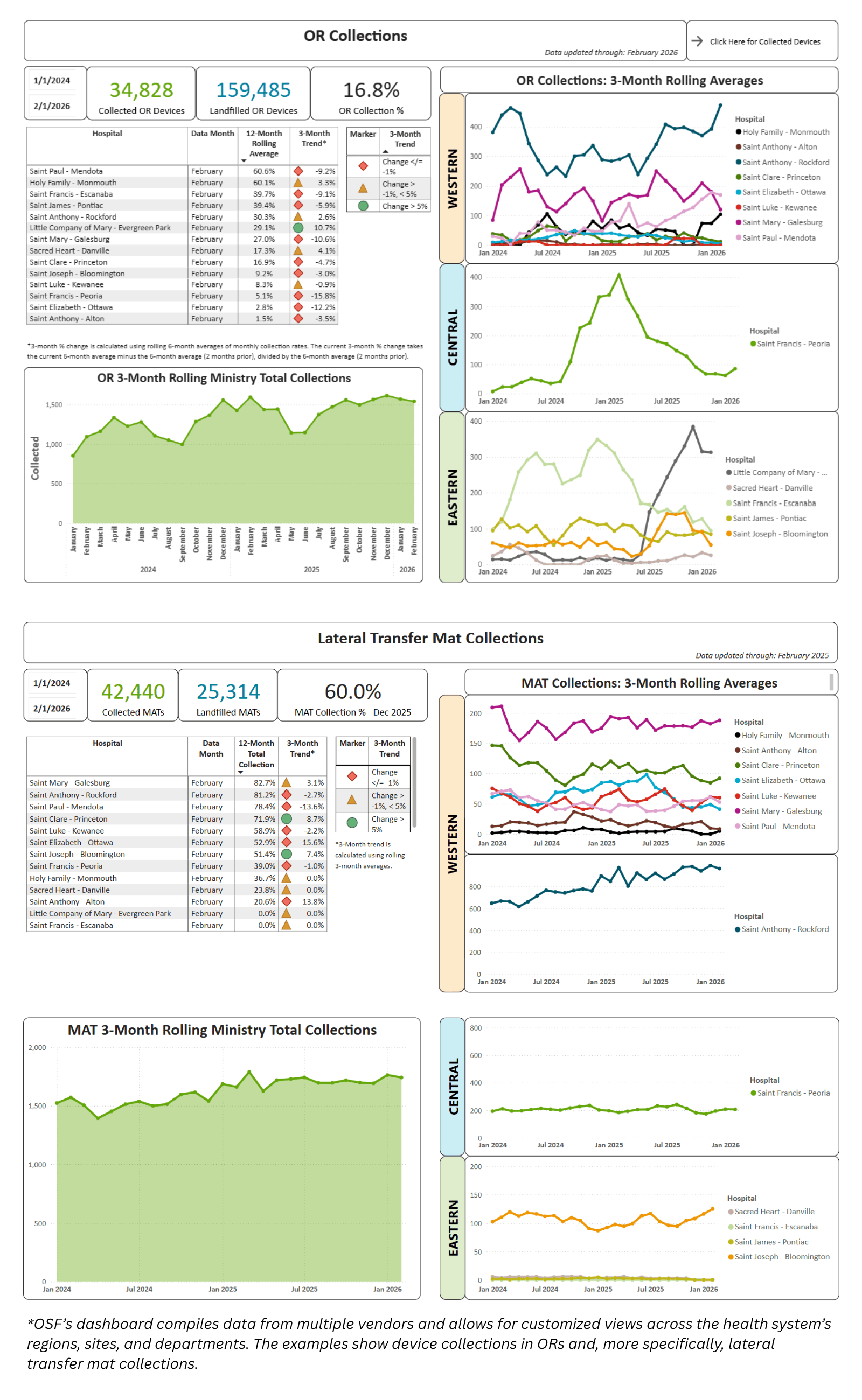
According to supply chain manager Angela Phillips, “The monthly oximeter and OR device collection reports were transformational. Seeing our trend improve over time was motivating, as was the comparison to other hospitals within our system.”
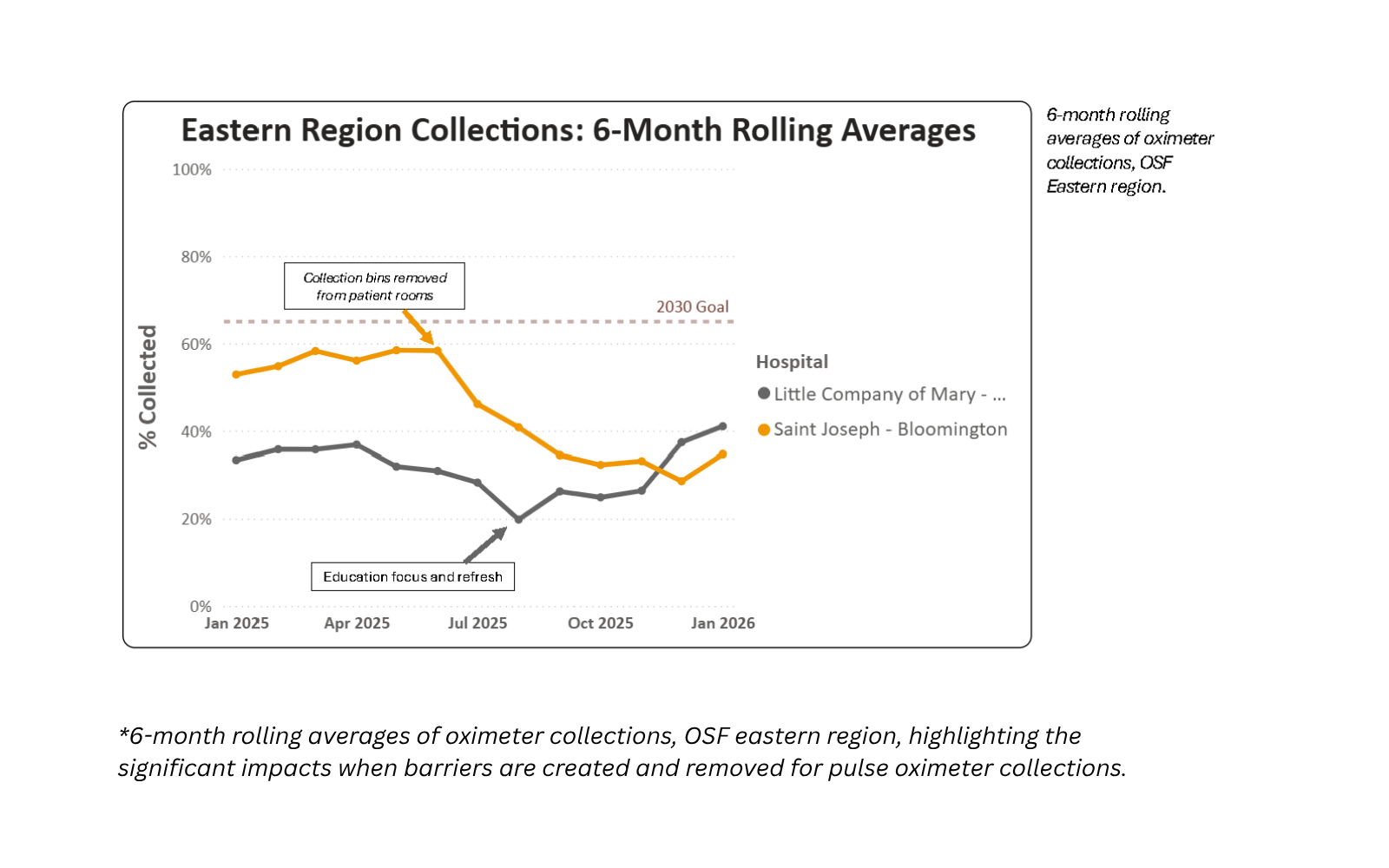
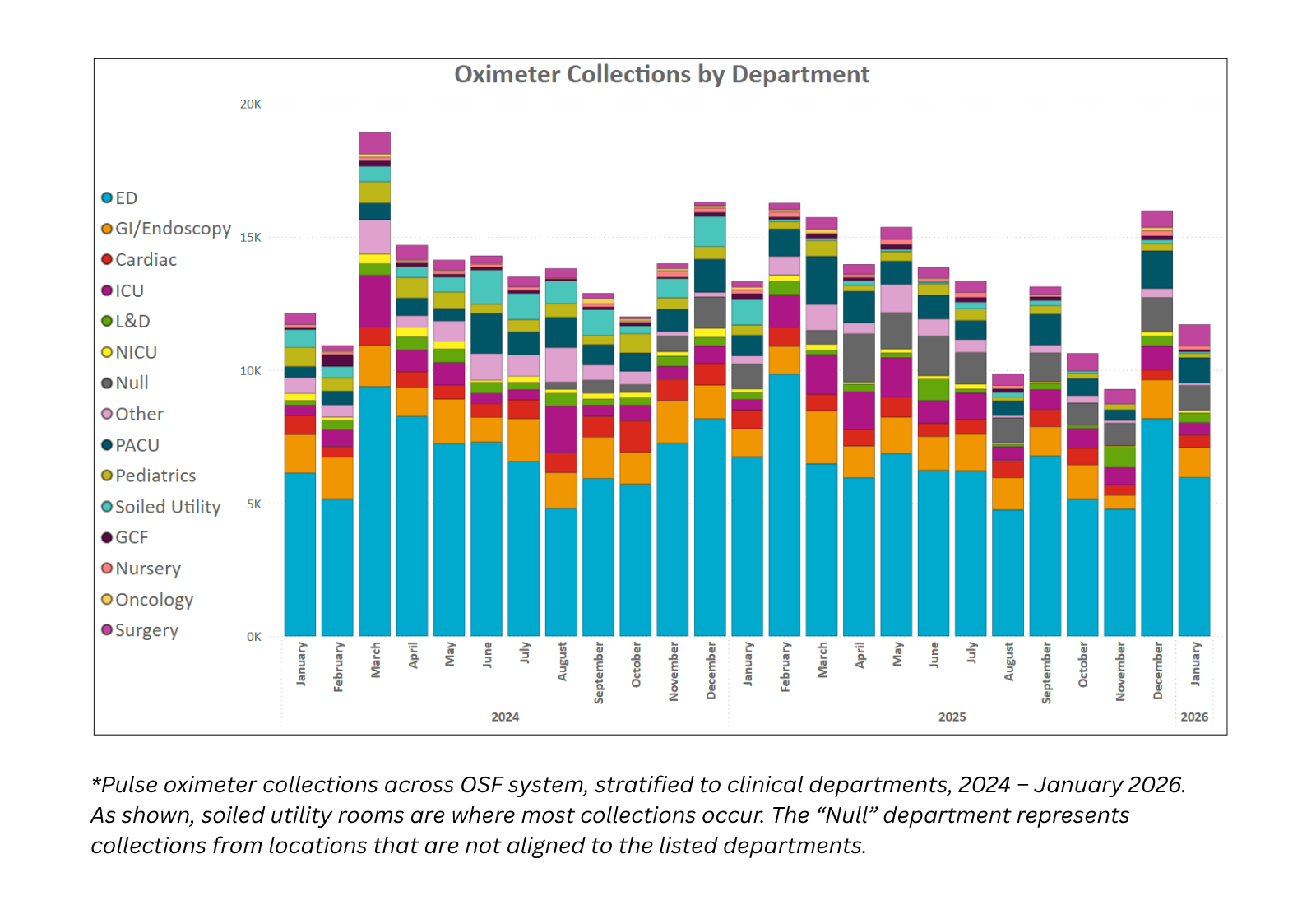
The SAMC team also benefited from insights from across the health system to inform their methods. Another OSF HealthCare hospital underwent room renovations, and pulse oximeter bins were not returned to the rooms, with collections decreasing significantly from about 58% to 28%, relative to what was purchased. By the same token, a hospital was able to show increased collections from a renewed focus on pulse oximeter collection education and signage. The SAMC team also had access to the very granular data, showing the specific locations or departments where pulse oximeters were being collected.
Going directly to the source
With robust reprocessing data in hand, the team conducted walk-throughs of the OR suite and selected inpatient areas, allowing participants from different perspectives to assess collection practices and operational constraints. Their combined expertise – from frontline clinical operations to supply chain and sustainability – helped translate observations from walk-throughs into actionable next steps.
These site walk-throughs and department-level discussions confirmed areas where SAMC was performing well, but they also uncovered barriers. Instead of assuming staff members were noncompliant, leaders asked: "What is getting in the way?" The team observed workflows, asked questions about bin placement, and talked to staff about their roles and behaviors. The walk-throughs also served a dual purpose to raise staff awareness and clarify expectations, for example, confirming how pulse oximeters are to be collected in inpatient areas.
Results
Data leads to better prioritization and decision-making
The health care environment is constantly changing, and not every initiative delivers immediate results. However, the new reporting and meeting structure the OSF team created helped them identify and address unexpected problems.
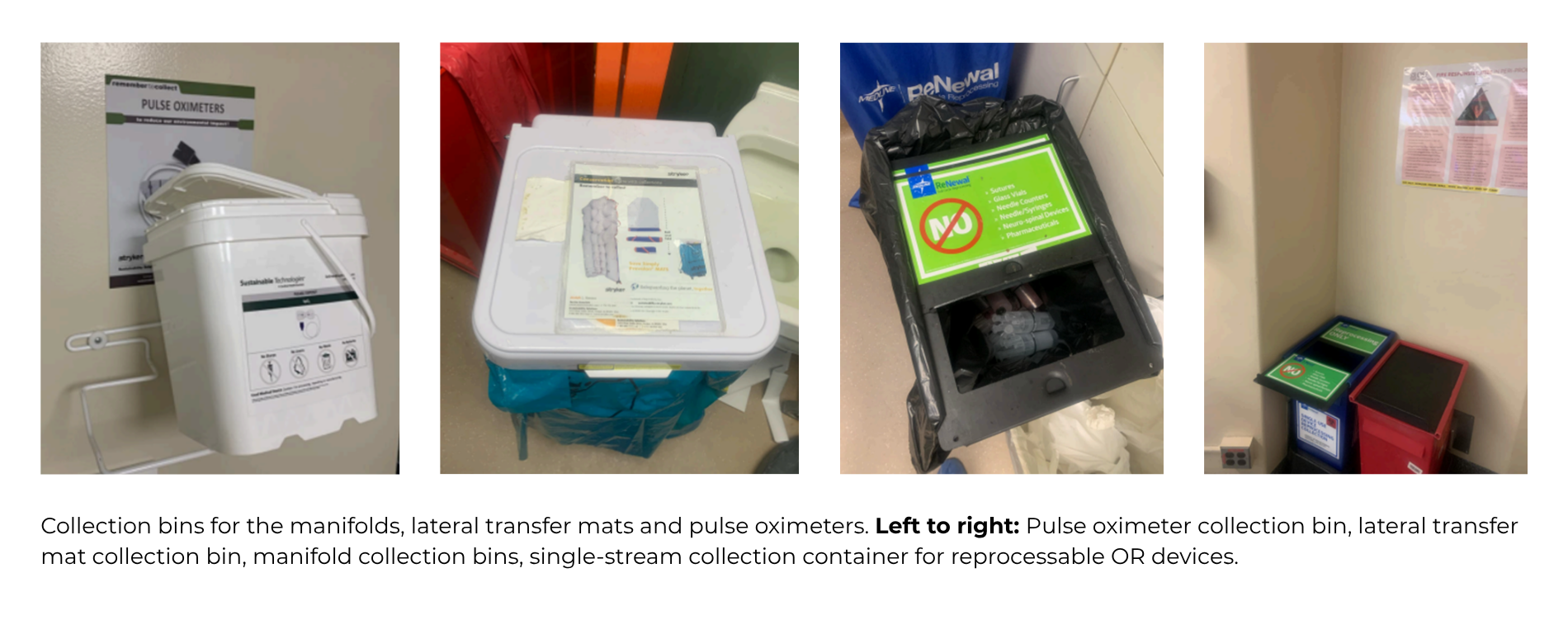
For example, using the device collection data dashboard, the team discovered a sudden drop in pulse oximeter collections, which was found to be due to a reorganization of collection bin placements. A trial of wall-mounted pulse oximeter collection bins in patient rooms was considered, but after consultations with numerous stakeholders, the SAMC team chose to reinforce the existing process and redirected the effort toward education and workflow reinforcement for collections in soiled utility rooms (where dirty items are collected before cleaning). They intensified education for inpatient clinical staff about where used oximeters should be disposed of and for EVS staff during discharge cleaning. Leaders provided sample bins and devices for hands-on training, and the team improved signage in soiled utility rooms to make it easier for staff to see the correct bins. Ongoing, consistent education for new staff is key to ensuring the topic remains top-of-mind for all existing staff.
Environmental impact and financial wins
To assess the results of the pilot, SAMC established a 6-month baseline from January to June 2025, and a comparable pilot timeframe from July to December 2025. Of the categories targeted, manifold collections improved by 38%, and lateral transfer mats, which were already being collected at a high rate, improved in absolute terms by 3.3%. The ratio of mat collections to purchases improved from 81.2% to 82.1%.
Taken together, the improvements in manifold and mat collections during the pilot represent about 650 pounds of plastic waste that were avoided annually. In 2025, SAMC saved almost $275,000 from purchasing blended SKU lateral transfer mats.
Across the health system, OSF experienced decreases in collections of pulse oximeters for a variety of reasons, such as changes in workflows and bin placements. SAMC also saw a reduction in collections, albeit less than the average for the system, and with the measures taken during the course of the pilot, some gains may yet be realized. Nonetheless, by buying back multiple blended SKU pulse oximeters in 2025, SAMC still achieved an annual savings of about $100,000 and is estimated to reduce GHG emissions by 2 MTCO2e.
As Adams observes, “Medical device reprocessing occasionally receives a negative perception due to collection logistics and contracting complexities. In reality, it can generate significant cost savings. With consistent, recurring education and thoughtful collection strategies, organizations can realize these savings with relative ease.”
Most importantly, the pilot at SAMC established a durable infrastructure for lasting change. The team standardized reporting practices. Department leaders now review reprocessing metrics on a regular basis, and the team has embedded reprocessing conversations in ongoing education. The stakeholder team continues to meet, refining strategy based on data rather than assumed steady state performance. The initiative evolved into a structured, data-driven operational program – one that successfully links environmental stewardship with smart financial spending, plastics reduction, and reducing GHG emissions.
Beyond the pilot: A foundation for lasting change
The SAMC pilot created new opportunities that extend beyond the initial project scope. Supply chain contracting leaders are reconsidering reprocessing buyback options when contracts are negotiated and communicating when there is some flexibility in existing contracts for buyback. SAMC started a trial of a reprocessed hysteroscopic tissue removal device (device used to remove tissue during a procedure) to obtain feedback and approval from clinicians regarding its use.
This was critical, as the adoption of reprocessed devices required careful management – some physicians raised concerns regarding quality and reliability, particularly for fibroid procedures. Taking the feedback into account, the team determined that approximately 45% of annual demand could reasonably transition to reprocessed devices. This strikes the right balance for maintaining limited OEM inventory to preserve clinician confidence while capturing the opportunity to increase reprocessed device use.
These adaptations taught a broader lesson: sustainability initiatives succeed when they respect clinical judgment, adapt to operational realities, and provide continuous feedback. Based on the recent trial, it’s estimated that by the end of 2026, SAMC could save over $20,000 and reduce Scope 3 emissions by almost another 100 kg CO2e as a result of buying back this reprocessed device.
Evaluating contracts
OSF also reviewed contracts for sequential compression devices, which are used to improve circulation and prevent blood clots, to investigate a blended SKU opportunity. OSF expects to move forward with a new contract for buying reprocessed compression devices in 2026.
Obtaining better emissions data
To drive decision-making with sustainability benefits other than landfill diversion, OSF collaborated with a vendor and consultant to create a lifecycle assessment for lateral transfer mats. Once complete, OSF will be able to estimate the Scope 3 greenhouse gas emissions reductions from the buyback of the mats. At the time this case study was written, preliminary calculations for 2025 estimate that SAMC may have reduced emissions by a total of 20 to 30 MTCO2e.
Sharing lessons learned
During the course of the pilot, SAMC benefited from seeing device collection data from across OSF and learning from other hospitals’ experiences. Likewise, the pilot informed other OSF hospitals about improving their reprocessing programs.
The success of the pilot drew attention from external partners. Travis Cunningham, a sustainability specialist at Medtronic, shares his perspective: “As our partner in sustainability, we’re proud to support and witness the commitment of OSF HealthCare to reducing waste and promoting a healthier environment. Their consistent efforts in the [pulse oximeters] sustainability program are diverting significant amounts of waste from landfills. Landfill diversion of health care supplies are not only minimizing the environmental impact of the hospital but also setting a standard of excellence for the entire health care industry.”
Jake Lyonfields, sustainability strategy manager for Practice Greenhealth, affirmed the project's success by concluding, "Single-use device reprocessing has enormous potential to reduce carbon emissions and create financial savings. OSF is pursuing every bit of that value through their significant investment in stakeholder engagement, robust data analysis, and thoughtful on-the-ground interventions. OSF has transformed their reprocessing program into one that's best-in-class."
About OSF HealthCare:
OSF HealthCare is an integrated health system that was founded by the Sisters of the Third Order of St. Francis.
Headquartered in Peoria, Illinois, OSF HealthCare employs almost 27,000 Mission Partners in 170+ locations with 18 inpatient facilities, including 16 hospitals, with 2,141 licensed beds. Additionally, there are 158 OSF Medical Group primary care and specialty care clinics, 39 urgent care locations, and two colleges of nursing throughout Illinois and Michigan.
The OSF HealthCare physician network employs more than 2,433 primary care, specialist, and advanced practice providers.
Accordions Groups
Description group accordion
Footnotes
Accordions
Join Practice Greenhealth
Practice Greenhealth is the health care sector’s go-to source for information, tools, data, resources, and expert technical support on sustainability initiatives that help hospitals and health systems meet their health, financial, and community goals.

Who We Are
Practice Greenhealth is the leading sustainable health care organization, delivering environmental solutions to more than 1,500 hospitals and health systems in the United States and Canada. Partnership opportunities include hospitals, health systems, community health organizations, NGOs, nonprofits, government, academic institutions, and the health care value chain.