
Beth Israel Deaconess Medical Center: Plant-forward eating pays off
Food purchasing | Case study
"For years, the sustainability and health benefits of serving plant-rich meals have been clear – but translating those wins into financial language that resonates with CFOs has proved difficult. The BIDMC team developed a rigorous, validated methodology to make the business case for plant-rich meals in their own institutions, and any Coolfood signatory can use it to do the same."
– Jenny Arthur, Head of Coolfood
KEY TAKEAWAYS
|
The challenge
Doing right by the planet is one thing; proving it makes financial sense is another. The team set out to translate the environmental progress into language a CFO would act on.
Seven years in the making
Avery Palardy remembers when the work began nearly seven years ago. She started building a sustainability program at Beth Israel Deaconess Medical Center (BIDMC) in Boston, the way most of these efforts start: passionate volunteers, pilot projects, and a handful of clinicians who believed a hospital could deliver extraordinary care and still take care of the planet. She didn't tackle it alone – the work drew on colleagues across sustainability, environmental service, perioperative, finance, and food service, building a team that would prove essential to everything that followed.

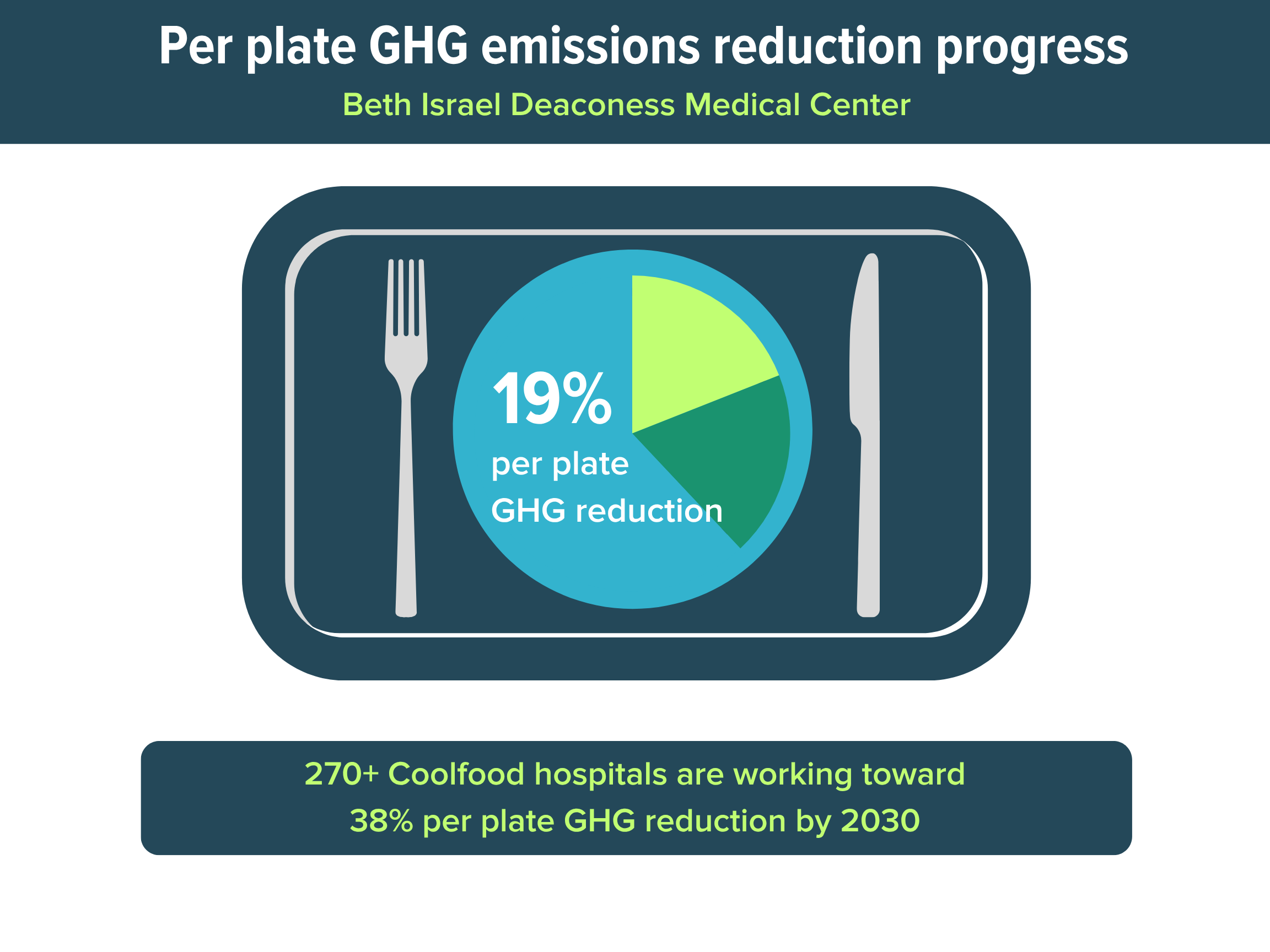
That grassroots effort grew into something much larger. Today, Palardy serves as executive director of climate and sustainability for Beth Israel Lahey Health (BILH), a 14-hospital system in which BIDMC is a founding member. The program that she and her team helped to build has earned top marks in Practice Greenhealth’s annual Environmental Excellence Awards and delivered real results: an 89% reduction in volatile anesthetic gas emissions since 2016, a 23% reduction in energy-related greenhouse gas emissions, and – most relevant to this story – a 19% reduction in food-related greenhouse gas emissions per plate since BIDMC signed the Coolfood Pledge in 2019.
The Coolfood Pledge target calls for signatories to achieve a 38% relative reduction in food-related emissions per plate by 2030. More than 270 hospitals have joined the Coolfood Pledge, and BIDMC's 19% reduction in emissions per plate remains ahead of group progress through 2024.
The missing piece
The team kept running into the same problem: they could demonstrate environmental progress at BIDMC, but translating that progress into a financial argument to scale the program to every hospital in the system was another matter entirely.
In a large health system, sustainability competes for resources alongside clinical priorities and operational demands. Without a clear financial story, strong environmental results risk being treated as a niche concern rather than a core business strategy. Considering Coolfood's effectiveness in reducing emissions for BIDMC, Palardy wanted to scale this work across all 14 BILH hospitals. To do that, the team needed the numbers, so Palardy set out to determine if seven years of environmental progress at BIDMC actually saved costs.
Palardy consulted Misun Kim, BILH’s senior sustainability analyst, to find out if the numbers backed the progress. With a background in the hospitality industry working with hotels and casinos where food purchasing data is tracked with precision, Kim knew how to ask the right questions of a complex dataset.
Collaborating with colleagues across finance and food service, Kim took on a challenge that was harder than it looked. Measuring cost savings from reducing animal products and food purchasing is not straightforward: prices fluctuate, purchasing volumes shift, and inflation distorts year-over-year comparisons. Any methodology that didn't account for all of these variables would not hold up to scrutiny – and without a credible analysis, the case for system-wide scaling would stall.
Ready to run this analysis at your facility?The plant-based cost avoidance methodology was built to be replicable. If your hospital is a Coolfood Pledge signatory, you already have the data you need. |
The solution
A sustainability analyst and cross-functional team cracked the code on measuring the financial value of plant-forward food – using existing Coolfood data
Finding the method that works
Kim started with the data that BIDMC was already collecting for Coolfood reporting. She tested three methodologies. Two fell short: one couldn't account for inflation, and another was too broad to be meaningful. The third worked.
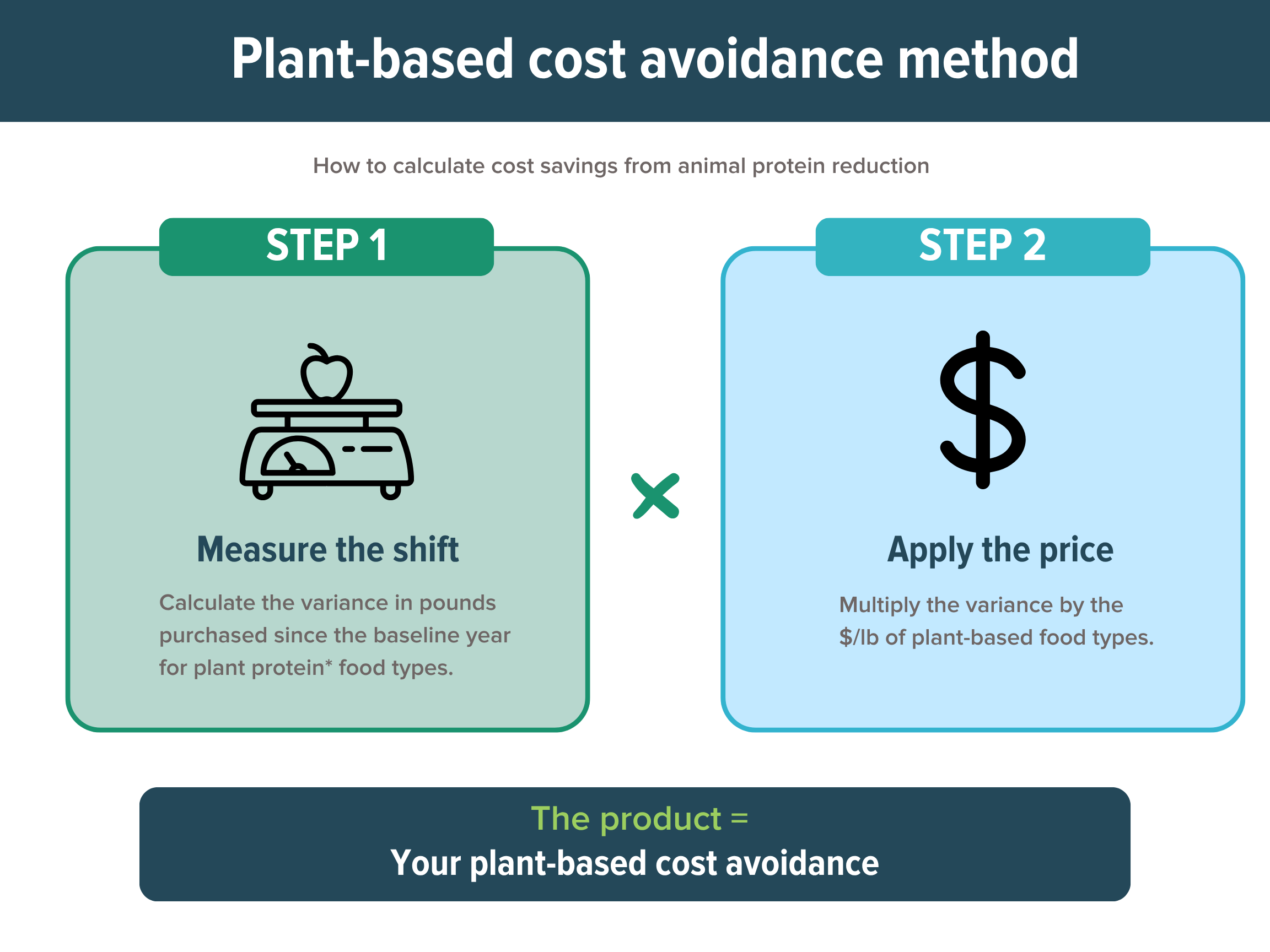
The team called it the “plant-based cost avoidance method.” By measuring the cost avoided by replacing higher-priced animal proteins with plant proteins using standardized purchasing and pricing data, this approach accounts for the price fluctuations, focuses on the specific purchasing shifts made for Coolfood, and uses food purchase data that signatories are already collecting.
Under Coolfood, plant proteins include legumes, such as beans, lentils, soy, and peas; nuts and seeds; grains; and plant-based meat and dairy alternatives. The cost avoidance methodology specifically tracks the shift away from animal proteins toward these plant proteins
“I tested three different approaches before landing on one that actually worked. The key was staying focused on what we could measure accurately – the purchasing shifts we made deliberately, not all the noise around them. Once you have a clean methodology, the data tells a clear story.”
–Misun Kim, Beth Israel Lahey Health senior sustainability analyst.
The analysis didn't happen in isolation. Bringing it to life required close collaboration across sustainability, finance, and food service – including BIDMC’s long-standing partnership with Sodexo – with each contributor bringing the data, operational knowledge, and context that made the methodology credible and actionable
Data analysis experts from Health Care Without Harm and the World Resources Institute reviewed the methodology and confirmed it was credible, transparent, and replicable.
Another important member of the team was Practice Greenhealth, the leading membership and networking organization for sustainable health care, who provided technical assistance throughout. Practice Greenhealth connects Coolfood signatories with tools, data, resources, peer-learning opportunities, and expert guidance to help hospitals move from data collection to real, measurable impact. For BIDMC, that partnership helped turn a rigorous internal analysis into something any Coolfood signatory can use.
"The great thing about this is that Coolfood signatories already have everything they need to put a dollar figure on their plant-forward progress. Calculating the cost avoidance is simple - but it's a step that turns environmental progress into a business case that leaders can act on."
– Chelsea Tomek, Health Care Without Harm associate director of performance analytics.
Making plants delicious
The financial case rests on something more fundamental: actually getting diners to choose plant-forward food, which required years of collaborative work on menus, training, and presentation by the culinary team. Or as one former Sodexo chef described it, "As soon as you reframe the conversation to not be about ‘vegan and vegetarian’ and focus on plant-forward, this, in a chef’s mind, allows for more creativity that actually improves the taste of a dish and does not limit the fun.”
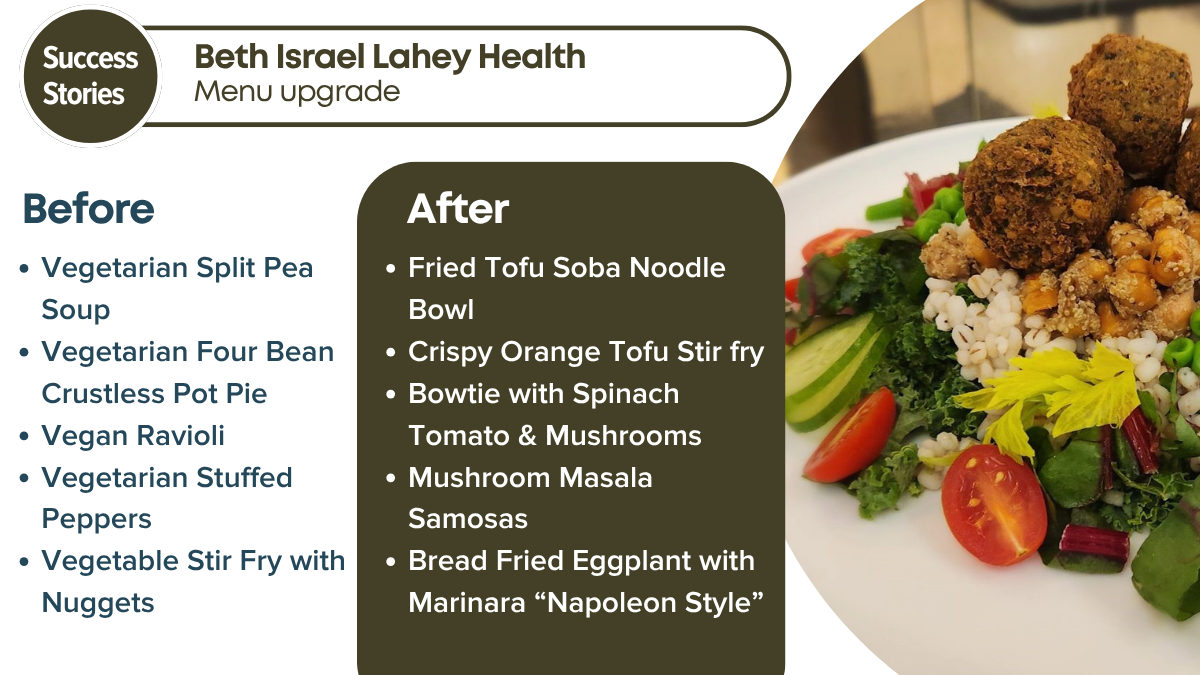
In practice, that means training front-line culinary staff, pricing plant-based options below animal-protein alternatives, and rethinking familiar dishes rather than introducing unfamiliar ones. Sodexo, BIDMC’s food service partner, has been a key collaborator in this effort – co-developing menus and executing the changes in kitchens that serve hundreds of people every day. The menu upgrade below shows what transformation looks like in practice.
What diners say
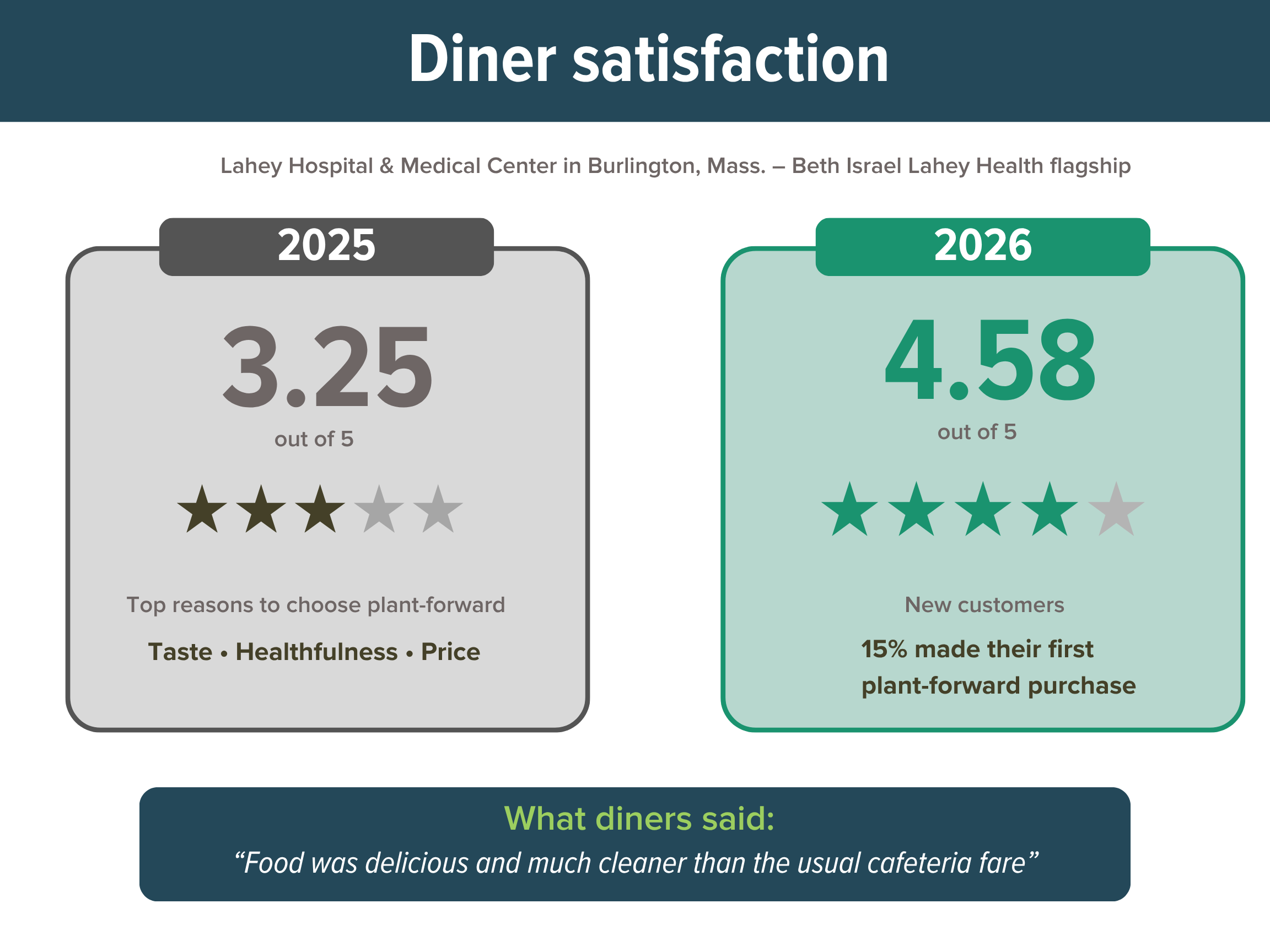
To track how the strategy was landing with diners, the team ran surveys at Lahey Hospital & Medical Center in Burlington, Mass. – a fellow BILH flagship – on plant power days when plant-forward options take center stage. The results across two years reveal a striking shift.
In 2025, 79 people took the survey and rated their experience 3.25 out of 5. Taste and healthfulness were the top reasons diners chose plant-forward options. By 2026, satisfaction had jumped to 4.58 out of 5. 15% of that year's respondents said they had never purchased a plant-forward item before that day.
The results
The proof is in: plant-forward is better for the planet, better for diners, and better for the bottom line.
The numbers that changed the conversation
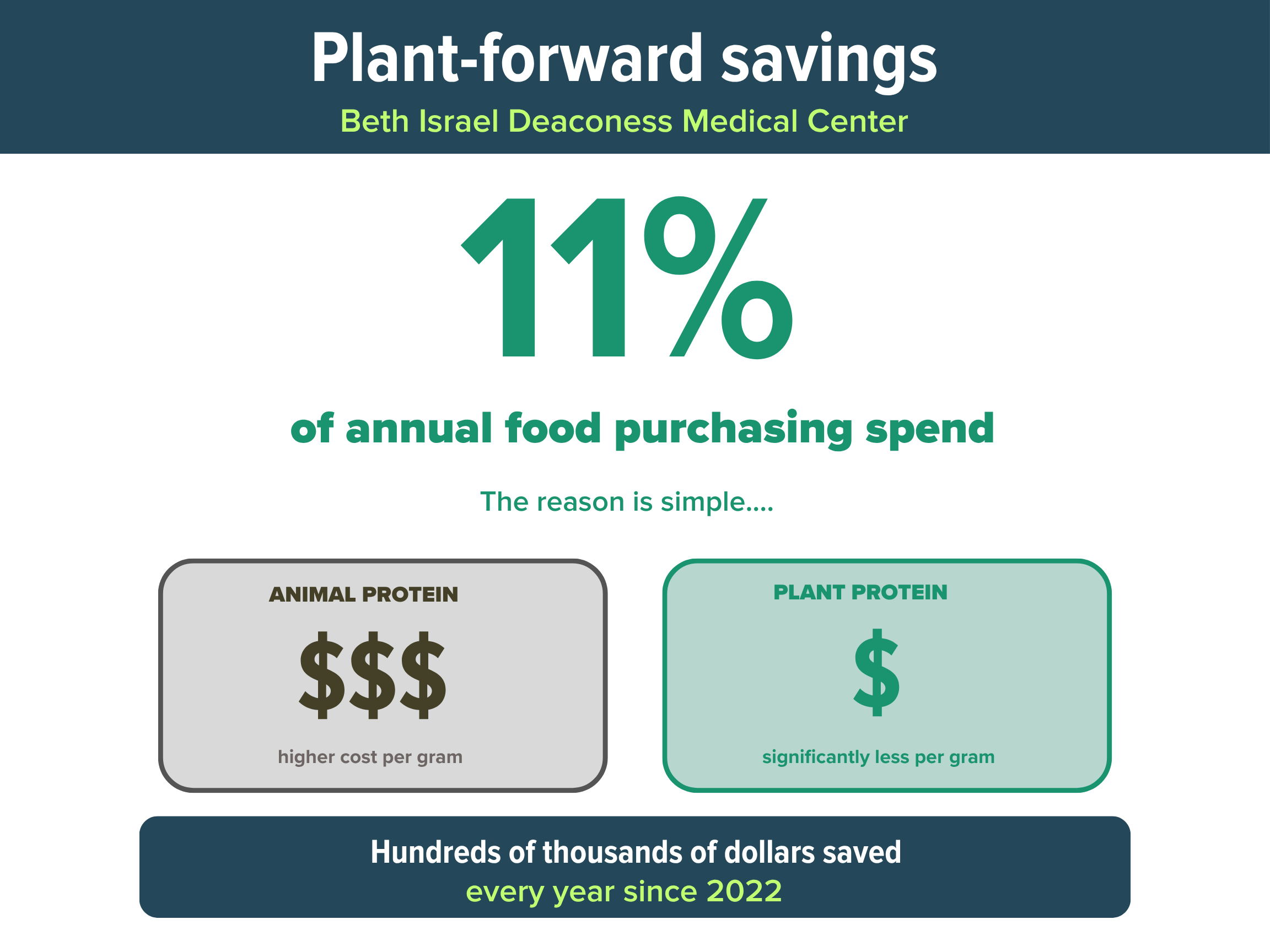
When Kim ran the analysis, the result was clear: going plant-forward saves money. Since 2022, plant-forward purchasing at BIDMC has achieved cost avoidance averaging over 11% of annual food purchasing spend each year. The reason is simple – plant proteins cost significantly less per gram than animal proteins.
The environmental results are just as strong. Over seven years, BIDMC has cut their per plate GHG emissions by 19% – ahead of the reductions achieved by U.S. and global Coolfood health care signatories.
As Palardy explains, “If sustainability is going to scale in health care, it must align with how decisions are made. This methodology translates environmental impact into financial terms that leaders can act on.”
These insights have changed the conversation inside BIDMC. The team now brings Coolfood results into quarterly business reviews with Sodexo, reframing plant-forward purchasing as a shared strategy that delivers both environmental and financial value – not a stand-alone sustainability program.
Building for scale
BILH has taken the methodology and built it into a system-wide dashboard tracking food purchasing, cost, cost avoidance, and emissions data across all 14 hospitals. What a team built at one hospital is now the foundation for a system-wide strategy.
The next steps are already in motion. Surveys show that health benefits drive most diners' food choices, so the team is working to more explicitly connect plant-forward options with health outcomes. They're also exploring food waste tracking through Leanpath to understand where waste occurs and how menu planning can reduce it.
A model built to travel
Perhaps the most important outcome of this work doesn't show up in BIDMC's numbers. It's the methodology itself. Any hospital in the Coolfood Pledge already collects the food purchase data needed to run this analysis – the plant-based cost avoidance method is documented, independently validated, and ready to use.
"BIDMC's work is a significant milestone for the Coolfood community," Jenny Arthur, the head of Coolfood, explains, "For years, the sustainability and health benefits of serving plant-rich meals have been clear — but translating those wins into financial language that resonates with CFOs has proved difficult. The BIDMC team developed a rigorous, validated methodology to make the business case for plant-rich meals in their own institutions, and any Coolfood signatory can use it to do the same. This kind of contribution and collaboration moves the whole field forward.”
For sustainability leaders making the case to skeptical executives, this is the piece that has been missing: a clear, credible way to show what greenhouse gas reductions are worth in dollars. Now it exists – because a team in Boston decided to build it.
For Palardy, who started this work with passionate staff volunteers, this is exactly the kind of change that she and her team set out to make.
“What started with passionate staff, pilot projects, and clinician-led curiosity has evolved into governance, strategy, data, and culture change. We're proof that change often starts small – and grows through collaboration, persistence, and purpose. "
– Avery Palardy, Beth Israel Lahey Health executive director of climate and sustainability
About Beth Israel Deaconess Medical Center
Beth Israel Deaconess Medical Center (BIDMC) is a 743-bed leading academic medical center located in Boston, and a founding member of the Beth Israel Lahey Health system. As a principal teaching hospital of Harvard Medical School, BIDMC combines clinical care, research, and education within a large and complex health care organization. The medical center has a long-standing commitment to sustainability and climate-smart health care operations, and has been a signatory of the Coolfood Pledge since 2019.
Join Practice Greenhealth
Practice Greenhealth is the healthcare sector’s go-to source for information, tools, data, resources, and expert technical support on sustainability initiatives that help hospitals and health systems meet their health, financial, and community goals.

Who We Are
Practice Greenhealth is the leading sustainable healthcare organization, delivering environmental solutions to more than 1,500 hospitals and health systems in the United States and Canada. Partnership opportunities include hospitals, health systems, community health organizations, NGOs, nonprofits, government, academic institutions, and the healthcare value chain.