
University of Vermont Health: Proving ROI on reusables & clinical plastics reduction
Plastic waste | Case study
“This initiative resulted in not only decreased use of disposables, but other results as well. It was the first pilot with the inpatient nursing team led by the sustainability department, and as such provided opportunities to increase engagement with a large group of employees and leaders.”
– Diane Imrie, system director of sustainability.
KEY TAKEAWAYS
|
The challenge
The University of Vermont Health (UVMH) is a rural academic health system serving 1 million people across Vermont and Northern New York, anchored by the UVM Medical Center in Burlington (UVMMC). With 562 acute care beds and 1.3 million patient encounters annually, it is closely affiliated with its academic partner, The University of Vermont, specifically the Larner College of Medicine and College of Nursing and Health Sciences. It’s home to the UVM Cancer Center and UVM Children’s Hospital. The hospital currently employs 7,150 people.
A new integrated approach to sustainability
While UVMMC has had a long-standing commitment to environmental stewardship, it historically relied on grassroots efforts across many departments and was not centrally coordinated across the health system. In 2024, UVMMC recognized that sustainability needed to be endorsed at the highest level, and Diane Imrie, who was one of the system’s long-time sustainability champions, became the system director of sustainability.
In the same year, Monique (“Mo”) Citro, who is both UVMMC’s perioperative communications specialist and UVMH’s sustainability strategist, identified that disposable blood pressure (BP) cuffs were generating significant waste. Imrie and Citro then gathered data from UVMH’s supply chain department and found there was significant spend on disposable BP cuffs, which was spread across three brands of products that were available for order due to different clinical needs.
After assessing the procurement data and taking into account some complexities, such as the range of BP cuff brands and sizes, and the various settings in which they were used, cardiology departments seemed to be the best opportunity for transitioning to reusables. This new initiative became one of the first efforts undertaken within the new, official organizational structure for sustainability.
Paving the way for reusable alternatives
In the fall of 2024, Citro conducted outreach to managers and educators for all the cardiology departments, including the cath lab, non-invasive cardiology, the patient floors, and interventional radiology, culminating in a cross-departmental meeting in December 2024. Citro then met with the system’s supply chain and infection prevention and control (IPC) departments in February 2025 to gain the necessary approvals for converting to reusables. The key feedback received from IPC was:
- For the preferred reusable BP cuff, the manufacturer's instructions for use require water rinsing after cleaning and disinfection, which can make compliance more challenging in practice.
- The instructions require inspection for deterioration, closure integrity, and leak testing. At the time, it was unclear who would perform inspections and at what frequency.
- 10% bleach wipes were approved and met cleaning and disinfection requirements.
Despite some early momentum, by the spring of 2025, progress slowed with clinical departments that would not commit to any changes, with the exception of the cardiovascular unit. The cardiovascular unit (CVU) is a procedural pre-op and recovery area for cardiology and interventional radiology departments. The unit has 25 staff members which includes nine registered nurses (RNs) and four support staff. They average 40 patients per day with an average of 40 cuffs used.
Christie Gordon, RN III, and a cardiovascular nurse professional development practitioner, became the unit’s champion for the initiative. Additional support and approval came from Gayle Hagen-Peter, RN, a CVU nurse manager. In July 2025, a rollout of reusable BP cuffs was launched in CVU, but after just one week, many of the reusable cuffs went missing, and the unit reverted back to disposables.
Explore immediate cost savings through waste reductionUniversity of Vermont Medical Center’s successful pilot in a high-volume cardiovascular unit demonstrates that converting to reusable blood pressure cuffs can achieve a return on investment in under one month, cutting disposable purchasing by $1,400 per month, and providing a streamlined model for scaling plastics reduction. This change is also projected to avoid 500 pounds of waste and more than 1 MTCO2e per year. Leverage Practice Greenhealth’s tools, peer learning, and technical assistance to navigate barriers and accelerate progress. Practice Greenhealth's Sustainable Procurement Guide provides step-by-step guidance, tools, and resources for health care organizations to develop a sustainable purchasing strategy that prioritizes community and environmental health and safety while reducing costs. |
“As with any change, communication is key...” – Gayle Hagen-Peter, RN, and cardiovascular unit nurse manager
The solution
After the initial conversion to reusable BP cuffs in the cardiovascular unit was unsuccessful, UVMMC partnered with Health Care Without Harm and Practice Greenhealth to conduct a new pilot to find an effective solution. Citro led a discussion with the CVU staff to reflect on the lessons learned from the first attempt.
Understanding the needs of staff to enable success
Lessons learned from the first initiative
Originally, the unit spent approximately $600 for reusable BP cuffs and distributed them in the patient bays, but almost as soon as the initiative started, the cuffs started to disappear. The project team treated these challenges not as setbacks, but as opportunities to strengthen the system for broader adoption. It was then that they realized that there were major training gaps and there needed to be new handling expectations and education for the support staff who were involved in the department, which included environmental services (EVS), patient transport, and nursing and patient care providers.
Key changes
Workflow modifications
According to Gordon, while not a huge lift, one of the more critical tasks was being clear at the onset about the necessary BP cuff sizes, colors, and brand, to ensure the correct replacements were used since there can be thousands of varieties offered.
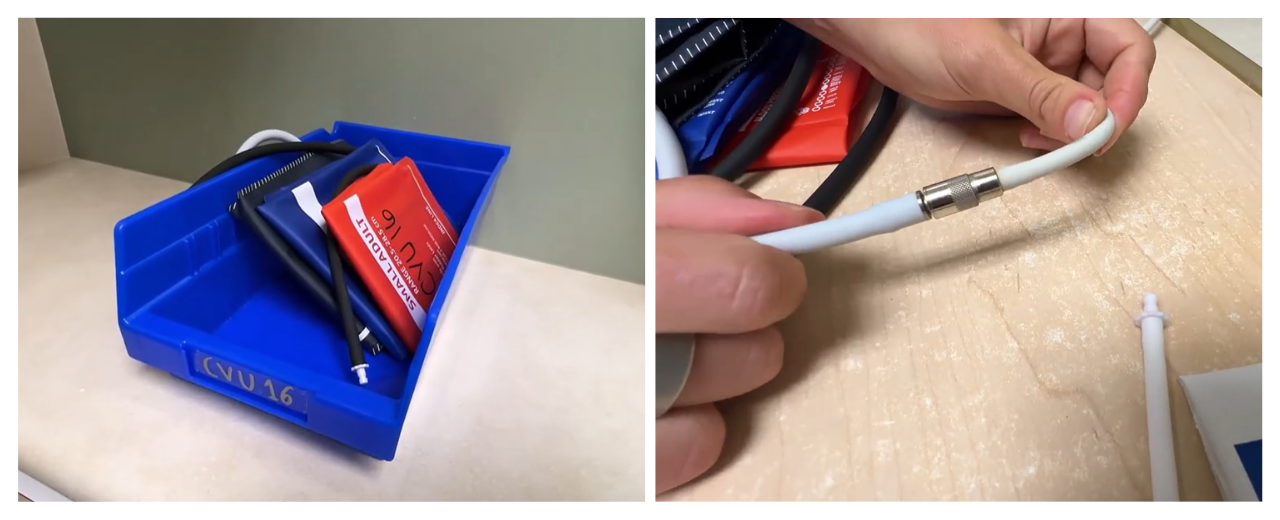
Providing clarity for staff on how to find and identify the right BP cuffs was also important. The new cuffs were stored at the head of the bed in each bay. Cuffs were color-coded to size, they wrote “CVU” on them to be able to identify them easily, and the bay number where the cuff was stored. All disposable cuffs were removed from the head of the bed and placed at the nurses' station, with the understanding that if an isolation patient came to the unit, a disposable cuff would be used rather than a reusable.
To prevent accidental ordering of disposables, distribution staff were informed of the change, and the barcode sticker that they would scan for reordering was removed. The previous reordering per size was 50 disposables.
Staff engagement and training
A video was created that outlined how to use the cuffs; how to connect them to the hose, how to clean and store them. The EVS, patient transport, and nursing teams were also each individually briefed on the process. The video and trainings helped communicate essential information to prevent loss of equipment, ensure consistent cleaning practices, and avoid reverting to disposables. The video proved to be especially useful for staff for whom English is not their first language. Staff reported that seeing a demonstration of the process was helpful. The video and in-service training were given on Sept. 4, and the rollout began the next day on Sept. 5.
According to Hagen-Peter, “As with any change, communication is key. Having prepped staff prior to initiating the process, informing them of the process and the benefits, cost, and environmental benefits, and acknowledging that the change will be an adjustment. We have the AM and PM staff ensure that the three most used sizes are in each bay, which helps us quickly identify if one is missing and troubleshoot what happened. For example, one procedural nurse removed a BP cuff from one room as her room didn’t have one, but we were able to track it down. Second, showing appreciation is very important. I thanked staff for this accomplishment that they achieved over messages, in staff meetings, and in my weekly CVU updates.”
The results
“The rollout for reusables went smoothly once there was buy-in at the clinical level, and patients did not notice a difference…”
– Christie Gordon, RN III, and cardiovascular nurse professional development practitioner
A usage report was run for the cardiovascular unit and found that from September 2024 to 2025 they purchased over 4,000 disposable cuffs totaling more than $12,000. The unit again invested in new reusable cuffs (20 of each adult size), and over the course of the pilot from September 2025 to January 2026, no single-use BP cuffs were purchased by the unit.
Significant environmental and cost savings discovered
The pilot reduced disposable purchasing by $1,400/month after the one-time investment. As reusable BP cuffs are expected to last 3 years, it can be expected that CVU could avoid an estimated 500 pounds of waste from single-use cuffs per year and more than 1 MTCO2e over the lifespan of the reusable cuffs purchased for the pilot.
These results were comparable to a 2019 study by Sanchez, et al. that conducted life cycle assessments for reusable and disposable BP cuffs in various health care settings and found that in many cases, GHG emissions can be reduced by approximately half with reusable BP cuffs, and in specific clinical situations, the reusables can generate up to 40 times less emissions. Similarly, while potential cost savings are highly dependent on the healthcare setting and cleaning protocol, the study found that in some cases, disposable BP cuffs can increase costs by almost a factor of 10.
The pilot further demonstrated the efficacy of the solution for both staff and patients. While reusable BP cuffs do require additional time and wipes for cleaning, it was determined that this aspect can be absorbed into existing processes, and the greatest benefit is derived when a patient is transported to different units and when the same reusable BP cuff stays with the patient rather than receiving a new one at each location.
On further reflection, Gordon said, “The rollout for reusables went smoothly once there was buy-in at the clinical level, and patients did not notice a difference since a proficient workflow was developed, ensuring there was enough time for dwell and air drying, so that cuffs were always clean and ready.”
Creating a new approach for single-use plastics reduction
After the successful pilot, UVMMC is looking to scale reusable blood pressure cuffs across the system. It’s estimated that 75% of disposable BP cuffs can be replaced with reusables, given that a quarter of the usage involves isolation cases. Additionally, UVMMC is starting to look for other opportunities, and the next step is determining high-volume products that are currently feasible for seeking alternatives.
According to Imrie, “This initiative resulted in not only decreased use of disposables, but other results as well. It was the first pilot with the inpatient nursing team led by the sustainability department, and as such provided opportunities to increase engagement with a large group of employees and leaders. This included all nurse leader education and an invitation to present the work and other sustainability initiatives at an upcoming nursing grand rounds. It also allowed us to test a grassroots, ad hoc approach versus the challenges of implementing a system-wide change. Learning from this provides a more streamlined template and process for future similar initiatives.”
About The University of Vermont Health
The University of Vermont Health is a rural academic health system serving 1 million people across Vermont and Northern New York, anchored by the UVM Medical Center in Burlington (UVMMC). With 562 acute care beds and 1.3 million patient encounters annually, it is closely affiliated with its academic partner, The University of Vermont, specifically the Larner College of Medicine and College of Nursing and Health Sciences. It’s home to the UVM Cancer Center and UVM Children’s Hospital. The hospital currently employs 7,150 people.
Join Practice Greenhealth
Practice Greenhealth is the health care sector’s go-to source for information, tools, data, resources, and expert technical support on sustainability initiatives that help hospitals and health systems meet their health, financial, and community goals.

Who We Are
Practice Greenhealth is the leading sustainable health care organization, delivering environmental solutions to more than 1,500 hospitals and health systems in the United States and Canada. Partnership opportunities include hospitals, health systems, community health organizations, NGOs, nonprofits, government, academic institutions, and the health care value chain.